You can picture the floor plan and finishes, but the success of your custom home starts with the dirt under your feet. In Wake Forest, the right homesite sets your budget, timeline, and design options long before you pick tile. If you want a smooth build and fewer surprises, you need a clear process to vet any lot. This guide gives you a step-by-step path with local resources so you can buy confidently. Let’s dive in.
Confirm jurisdiction and rules
Start by learning who regulates the property. Lots inside the Town of Wake Forest or its ETJ follow the Town’s Unified Development Ordinance. Standards for zoning, setbacks, grading, stormwater, and subdivision live here, and they are being updated over time. Review the current rules and ask about any active UDO changes that could affect your plan using the Town’s Unified Development Ordinance.
HOA covenants are separate from Town rules. Many subdivisions have recorded covenants that control home size, exterior materials, and architectural review. Request the recorded plat, deed, and any CCRs from the seller, then confirm them in county records. A boundary check and a title review will help you spot setbacks, easements, or restrictions early.
For parcel research and recorded data, a county parcel viewer is a good start. You can explore parcel datasets and recorded information references through the Wake County listings at county parcel data resources.
Utilities: water, sewer, and power
Public utilities vary by location. Inside the Town, many lots connect to Town water and sewer and are served by the municipal electric utility, Wake Forest Power. Always confirm service territory and any connection requirements with the utility before you assume you can tap in. Learn more about municipal electric service via Wake Forest Power.
Outside Town service areas, you may need a private well and an on-site wastewater system. If water and sewer are available, ask for a utility availability letter and whether capacity is reserved. The Town’s UDO and its Manual of Specifications set expectations for extensions and infrastructure. Review the Town’s standards under the Unified Development Ordinance.
Internet is highly location specific. Fiber is not uniform across Wake Forest. Check exact address coverage and speeds with providers using a coverage tool like InMyArea’s Wake Forest page, then confirm directly with the provider.
Septic, wells, and soils
If your lot will use septic, prove feasibility up front. Start with a desktop soils check using the NRCS Web Soil Survey. It flags soil series, slopes, and drainage that can hint at opportunities or challenges. Treat this as a screen only. You still need a licensed onsite-wastewater professional to perform field testing.
North Carolina requires permitted evaluations and designs for new septic systems, with local health departments issuing permits and inspections. For background on system siting and design, the EPA’s technical manual explains how soils and layout drive performance: Onsite Wastewater Treatment Systems Manual. Professional licensure and practice rules are set by the state. You can review the North Carolina rules for onsite wastewater professionals here: 21 NCAC Chapter 39.
For wells, ask for any existing well logs and consult a licensed well contractor about likely yield and water quality for the area. Plan sequencing carefully so your septic layout and well location meet required setbacks from each other and from property lines.
Topography, floodplain, and wetlands
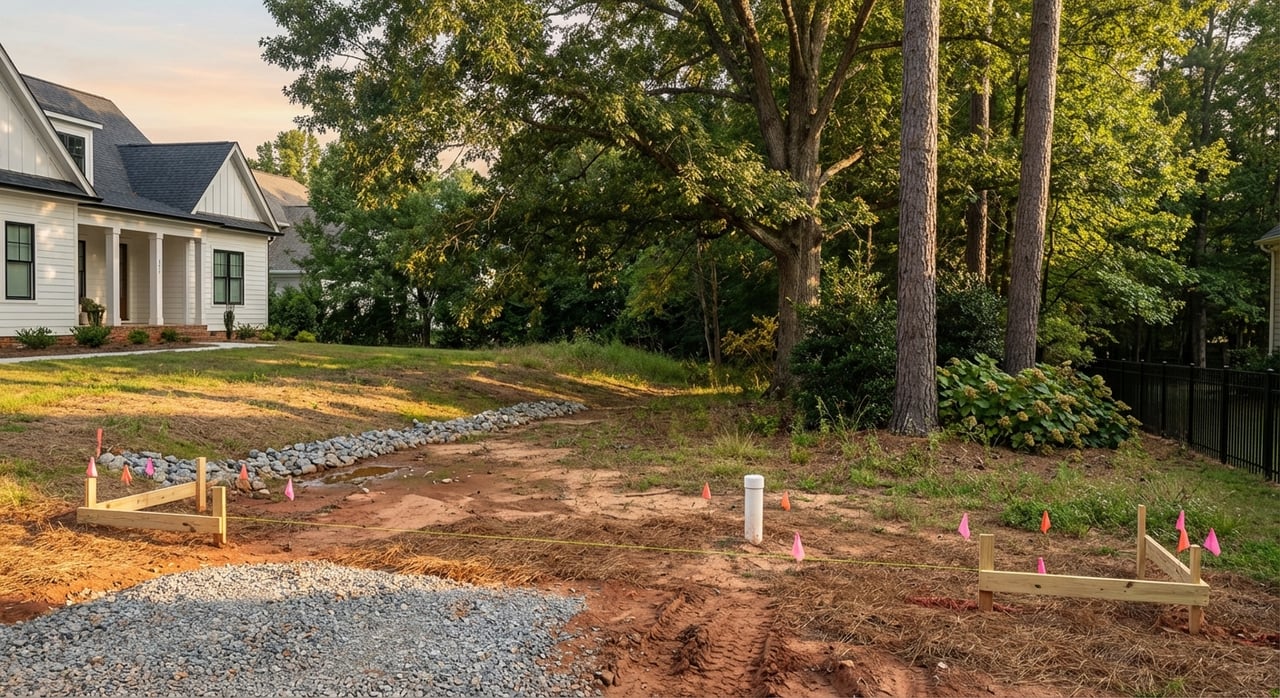
Topography shapes everything from your driveway design to foundation type. Walk the lot, look for drainage patterns, and budget for grading. Then check flood risk before you fall in love with a site. The Town’s floodplain resources link to FEMA and state tools and outline permit needs. If your lot intersects a Special Flood Hazard Area, you may face elevation requirements, insurance, or buildable-area limits. Start with the Town’s Know Your Flood Hazard, and review local permitting steps at Floodplain Development.
If you see streams, ponds, or low, saturated ground, ask about wetlands. The U.S. Army Corps of Engineers regulates impacts to jurisdictional wetlands and waters. If your build requires grading, a driveway crossing, or pond work in these areas, you may need a permit. Learn more about jurisdictional determinations and permits at the USACE’s regulatory overview: Federal Regulation and Permits.
Access, easements, and setbacks
Confirm how you will access the property. If your driveway ties into a state-maintained road, an NCDOT driveway or access permit may be required, and sight-distance or culvert standards could shape your design. In Town, development standards work alongside state rules, so discuss road classification and any required improvements with your builder and the planning staff using the Unified Development Ordinance.
Next, locate all easements and setbacks. Utility, drainage, or conservation easements can eliminate part of your building envelope. Ask for the most recent boundary survey that shows recorded easements and rights of way. For parcel-level records references, consult county parcel data resources.
Tree preservation and landscape standards
If you value mature trees, plan for preservation early. The Town’s UDO includes urban forestry standards that may require landscape and mitigation plans on some projects. A certified arborist can map significant trees and advise on protective measures before grading begins. See the Town’s urban forestry references here: Urban Forestry UDO.
Your due diligence roadmap
Use this simple sequence to lower risk and keep your build on schedule:
- Desktop screens before offering
- Verify Town limits or ETJ status, zoning district, and any overlay rules using the Unified Development Ordinance.
- Pull parcel records and look for plats, notes, or prior permits through county parcel data resources.
- Run a soils check with the NRCS Web Soil Survey.
- Screen flood risk with the Town’s Know Your Flood Hazard.
- Confirm likely utility providers and internet coverage using Wake Forest Power and an ISP coverage tool such as InMyArea.
- Early professional checks
- Order a boundary survey to confirm corners, encroachments, and easements.
- If not on public sewer, hire a licensed onsite-wastewater evaluator to test soils and map a septic layout in line with 21 NCAC Chapter 39.
- For steep or variable soils, engage a geotechnical engineer to define foundation options.
- Bring in your builder, architect, or civil engineer for a preliminary site plan and a cost estimate for clearing, driveway, utilities, and stormwater.
- If tree preservation matters, consult a certified arborist and review the Town’s Urban Forestry UDO.
- Regulatory and permits
- If in Town or the ETJ, ask Planning and Engineering about submittal needs and any recent UDO changes. Floodplain work requires a Town Floodplain Development Permit. Start at the Unified Development Ordinance and Floodplain Development.
- If using septic or a well, coordinate with the local health and well permitting authorities. Technical background is outlined in the EPA Onsite Wastewater Treatment Systems Manual.
- If access is to a state road, confirm driveway permitting with NCDOT and coordinate with Town staff where required.
- Contracts and title
- Have your attorney or title company review the title commitment for easements, CCRs, mineral reservations, and any conservation or flood easements.
- If there is an HOA, request architectural review guidelines and approval timelines to align with your builder’s schedule.
Smart questions for lot tours
- Is the lot inside Town limits, the ETJ, or unincorporated county, and what UDO or county standards apply?
- Which utility providers serve the parcel, and are there water/sewer availability letters or capacity constraints?
- Does any part of the site fall in a FEMA flood zone or local flood overlay, and what permits would be required?
- Are there recorded easements or known wetlands that limit the building envelope?
- Are existing surveys, soil reports, or prior septic approvals available?
When to call which pro
- Surveyor: as soon as you identify a lot so you can verify corners and easements.
- Onsite-wastewater evaluator or septic contractor: before you commit to an unsewered lot.
- Geotechnical engineer: when slopes, fill, or clay could affect the foundation or you plan a basement.
- Builder, civil engineer, and architect: early, to cost utilities, grading, stormwater, and house placement.
- Arborist or environmental consultant: if you want to preserve trees or suspect wetlands.
Budget traps to avoid
- Assuming public sewer or natural gas is available without confirmation. Service territory and capacity vary by micro-location.
- Underestimating driveway, grading, or stormwater work on sloped or wet sites.
- Ignoring easements or HOA setbacks that shrink your building envelope.
- Delaying septic, well, or utility availability checks. These often set the critical path for your schedule.
Choosing the right homesite in Wake Forest is a process, not a guess. If you follow the steps above, confirm service territories, test soils, and verify flood and access constraints, you will protect your budget and open up better design choices. If you want a seasoned partner to help source lots, read plats, and coordinate builder conversations, reach out to Chad Ross for local, hands-on guidance.
FAQs
What permits do I need to build a custom home in Wake Forest?
- If your lot is in Town limits or the ETJ, you will follow the Town’s UDO for zoning, stormwater, and floodplain rules plus building permits; unincorporated county lots follow county and state processes, with septic and well permits if applicable.
How do I know if a lot will need septic instead of sewer?
- Ask the listing side for utility details, confirm with the utility about water/sewer availability, and if sewer is not available, hire a licensed onsite-wastewater evaluator to test soils and design a system before you commit.
How can I check if a Wake Forest lot is in a flood zone?
- Use the Town’s floodplain resources that link to FEMA and state mapping tools, then confirm on-site elevations and permit needs with Town staff if any portion intersects the Special Flood Hazard Area.
Who provides electricity to a homesite in Wake Forest?
- Inside Town limits many parcels are served by Wake Forest Power; outside Town limits, service may be from a cooperative or investor-owned utility, so confirm the incumbent provider for the exact parcel before planning extensions.
What is the ETJ and why does it matter for my build?
- The ETJ is the Town’s extraterritorial jurisdiction. Lots in the ETJ follow Town development rules even though they sit outside corporate limits, which affects setbacks, stormwater standards, and plan review steps.